
 EN
EN
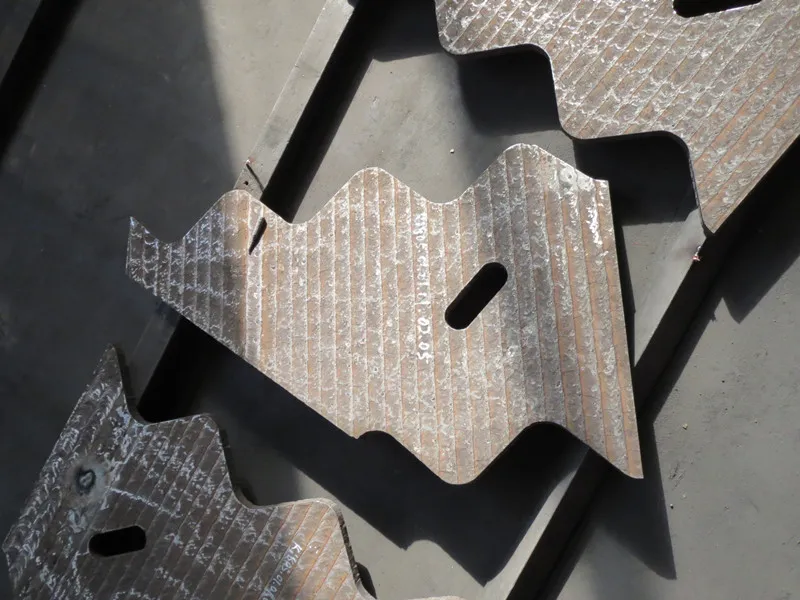
Understanding CCO Technology: Metallurgical Foundation for Wear Resistance
What Is Chromium Carbide Overlay (CCO) and Why It Excels in Abrasive Environments
Chromium Carbide Overlay, or CCO for short, works as a special kind of wear resistant coating process. Basically what happens is that high chromium carbides get fused onto a tough steel base material. Most often this is done through something called submerged arc welding technology. What we end up with is a super hard surface layer that measures between HRC 58 and 65 on the hardness scale. This makes it last anywhere from 3 to 5 times longer than regular abrasion resistant steels when put to work in those rough conditions typical of mining operations or cement processing plants. The real advantage comes from how the metal actually bonds together at a molecular level instead of just sticking mechanically. This full fusion approach stops the coating from peeling off even after repeated stress cycles. As a result, maintenance teams see fewer unexpected failures and replacement costs drop by more than 60 percent compared to equipment without this CCO treatment.
How CCO's Hardness, Microstructure, and Bond Integrity Outperform Conventional Hardfacing
CCO outperforms conventional hardfacing through three interdependent metallurgical advantages:
- Hardness Differential: With surface hardness of HRC 58–65, CCO exceeds typical hardfacing alloys (300–500 HBW) by more than 200% in Vickers-equivalent hardness—forming a resilient barrier against abrasive particles such as silica and iron ore.
- Optimized Microstructure: A uniform dispersion of chromium carbides within a tough, low-carbon ferrous matrix inhibits crack initiation and propagation while preserving impact absorption capacity.
- Fusion-Layer Integrity: Metallurgical bonding achieves >98% density at the interface, eliminating the porosity and weak interfacial zones common in thermal-sprayed or plasma-deposited coatings.
| Property | Conventional Hardfacing | CCO Technology |
|---|---|---|
| Surface Hardness | 300–500 HBW | 58–65 HRC |
| Wear Life | 1x (baseline) | 3–5x longer |
| Impact Resistance | Prone to cracking | Ductile base absorbs kinetic energy |
| Bond Strength | Adhesive or mechanical | Full metallurgical fusion |
This dual-phase architecture—brittle, wear-resistant carbides supported by a tough, energy-dissipating substrate—delivers exceptional durability in high-abrasion, low-to-moderate impact applications.
Strategic CCO Application: Maximizing Grinding Table Lifespan Through Targeted Recladding
Identifying High-Wear Zones on Grinding Tables for Precision CCO Cladding
Getting good results from CCO recladding starts with knowing exactly where the wear happens. When we look at things like thermal images, wear maps, and what's failed before, certain spots stand out again and again. Think about those impact points right under feed chutes, the places where materials slide along table edges, and the little pockets of erosion forming around grinding rollers. Focusing reinforcement efforts just on these problem areas instead of coating everything makes much better sense. We save money on materials and get real protection where it counts. Plus, this approach keeps the structure strong without making other parts of the table heavier or stiffer than needed, which can actually cause new problems down the line.
Lifecycle Cost Savings: How CCO Recladding Delays Full Replacement by 3–5
When done right, CCO recladding changes the game for grinding tables, turning what were once throwaway parts into valuable long term investments. The cost to fix those worn out spots is only around 60 to 80 percent of buying brand new equipment, and it keeps these tables working properly for another 3 to 5 production runs after repair. Plants report cutting maintenance stoppages by roughly 40 to 50 percent each year based on how things are wearing down across the industry. This method saves money upfront since companies don't need to replace everything all at once, plus there's less scrap going to landfills when parts get fixed instead of tossed away. For manufacturers looking to balance their books and green initiatives at the same time, recladding offers real financial benefits without compromising on sustainability goals.
Operational Best Practices to Preserve CCO Integrity During Grinding
Load Distribution, Feed Rate, and Thermal Management to Prevent CCO Cracking or Delamination
Operational discipline is essential to preserve CCO integrity. Excessive vibration, uneven loading, or uncontrolled thermal cycling accelerates micro-cracking and interfacial degradation. Proven mitigation strategies include:
- Distributing loads evenly across the grinding table to avoid stress concentrations at weld boundaries
- Maintaining feed velocities below 2.5 m/s to limit thermal shock and mechanical fatigue
- Applying directed coolant flow to maintain interfacial temperatures under 200°C
When implemented consistently, these controls reduce overlay failure rates by up to 60%, per field studies conducted across cement and mineral processing facilities. Crucially, they prevent destabilization of the chromium carbide phase structure—a known precursor to delamination.
Tooling Compatibility: Selecting Blades and Media That Minimize Interface Micro-Chipping
Tooling selection directly influences CCO longevity. Abrasives or cutting media harder than the CCO surface (e.g., >65 HRC) induce micro-fractures at the carbide–substrate interface, accelerating localized wear. Optimal choices include:
- Ceramic-bonded alumina abrasives (45–55 HRC), which erode controllably without damaging the overlay
- Diamond-tipped blades mounted with elastomeric dampening systems to absorb shock
- Rounded-edge media that distribute impact forces broadly rather than concentrating them
Adopting compatible tooling reduces interface chipping by approximately 40%, extending recladding intervals and maintaining consistent grinding performance.
FAQ Section
What is the primary advantage of Chromium Carbide Overlay (CCO)?
The primary advantage of CCO is its exceptional wear resistance, which is enhanced by metallurgical bonding that prevents peeling even under stress.
How does CCO technology compare to conventional hardfacing?
CCO technology offers superior hardness, optimized microstructure, and metallurgical bond integrity compared to conventional hardfacing.
What are lifecycle cost savings associated with CCO recladding?
Lifecycle cost savings arise from reduced maintenance stoppages and delayed full equipment replacements, saving 60-80% compared to buying new equipment.