
 EN
EN
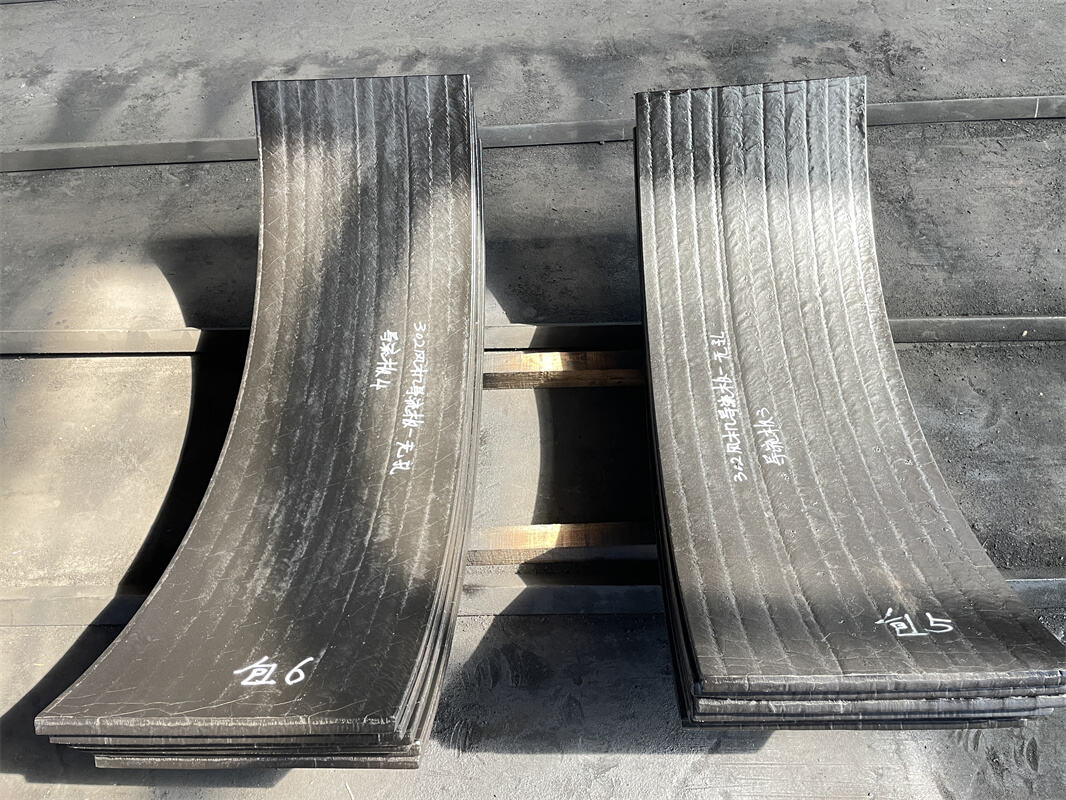
Unmatched Abrasion Resistance: How Chromium Carbide Overlay Extends Liner Life
The Metallurgical Edge: HRC 60–65 Hardness and Stable Carbide Microstructure
Chromium carbide overlay delivers unparalleled abrasion resistance through its unique metallurgical structure. With a surface hardness of HRC 60–65—significantly exceeding AR400 steel’s typical maximum of HRC 56—it resists degradation in demanding raw material handling systems. Its composition forms a stable matrix of chromium carbides embedded in a ductile steel substrate, delivering both hardness and structural integrity under repeated impact. Microstructural analysis confirms evenly distributed complex carbides that retain 94% of their hardness after thermal cycling, effectively suppressing crack propagation common in homogeneous steels. Crucially, no phase transitions occur below 1250°F (676°C), ensuring consistent wear performance across operational temperature fluctuations—even in hard-flowing slurry applications.
Real-World Validation: 3.2× Longer Service Life in Iron Ore Transfer Chutes
Field data from 15 iron ore operations validates the overlay’s lifecycle advantage: transfer chutes lined with chromium carbide overlay achieve 3.2× longer service life than those using AR500 steel. Replacement intervals extended from an average of every six months to 19–24 months of uninterrupted operation. This durability stems from the overlay’s resistance to micro-gouging by dense, high-Mohs particulates—particularly evident at a mine processing 12,000 tons daily, where maintenance frequency dropped 67% despite handling abrasive magnetite blends exceeding 9.0 Mohs hardness. In 18-month benchmark studies involving copper-rich ores—known to accelerate liner failure—wear penetration depth remained under 15%, with no spalling or fracture-induced flow disruption. The result is fewer unplanned outages and sustained productivity gains.
Strategic Application of Chromium Carbide Overlay Across Flow Zones
High-Impact vs. High-Friction Zone Mapping for Targeted Overlay Placement
Wear mechanisms vary significantly across chute and hopper surfaces—meaning uniform liner coverage is neither necessary nor cost-effective. High-impact zones (e.g., material drop points) experience repeated kinetic loading and require toughness to absorb shock without deformation. High-friction zones (e.g., slide surfaces) endure sliding abrasion and demand exceptional surface hardness. Chromium carbide overlay excels in both contexts, enabling precise, zone-specific application.
| Zone Type | Primary Wear Mechanism | Required Material Property |
|---|---|---|
| High-Impact | Impact deformation | Toughness, impact strength |
| High-Friction | Abrasive sliding | Hardness, wear resistance |
Mapping these zones during design or retrofit ensures overlay is applied only where it delivers measurable ROI—optimizing both liner longevity and capital efficiency.
From Reactive Replacement to Predictive Liner Lifecycle Management
Traditional liner maintenance follows a reactive “fail-and-replace” model—triggering unplanned downtime and emergency repair costs. By integrating zone-specific wear data from flow mapping, facilities can shift to predictive lifecycle management. Because chromium carbide overlay exhibits highly uniform, linear wear patterns—driven by its stable microstructure—operators can accurately forecast remaining service life per zone and schedule replacements during planned shutdowns. This proactive approach minimizes emergency outages, improves maintenance planning accuracy, and extends overall system uptime.
Chromium Carbide Overlay vs. Alternatives: Performance, Durability, and Total Cost of Ownership
ASTM G65 Data: CCO Delivers 4.7× Greater Abrasion Resistance Than AR500 Steel
ASTM G65 testing—the industry-standard dry-sand rubber-wheel abrasion test—confirms chromium carbide overlay (CCO) provides 4.7× greater abrasion resistance than AR500 steel. While AR500 relies on through-hardening or surface treatments vulnerable to thickness loss and accelerated wear in high-slip environments, CCO integrates a dense, interlocking network of chromium carbides (HRC 60–65) into a tough, tempered martensitic steel matrix. This dual-phase architecture resists both gouging abrasion and particle impact—making it especially effective at ore transfer points. When combined with reduced downtime and longer replacement cycles, this performance differential translates directly into lower total cost of ownership.
Impact Limitations of Ceramics: Why CCO Excels in Dynamic Chute Bends
Ceramic liners—though highly abrasion-resistant—are fundamentally limited in high-impact applications, particularly at dynamic chute bends. Their high compressive strength is offset by low fracture toughness; repeated strikes from coarse aggregate (>200 mm) induce micro-cracking, initiating cascading tile failure. Chromium carbide overlay avoids this weakness entirely: its ductile steel base layer absorbs impact energy via controlled plastic deformation, while the carbide-rich surface remains intact and resistant to pulverization. Mining operators consistently report 18-month service consistency in such demanding bends—without spalling—where ceramic alternatives fail prematurely. This balance of impact resilience and abrasion resistance makes CCO uniquely suited for complex, multi-mechanism wear environments—delivering not just superior performance, but broader application flexibility and long-term cost savings.
FAQ: Chromium Carbide Overlay
What is chromium carbide overlay and how does it work?
Chromium carbide overlay is a composite material consisting of chromium carbide particles embedded in a steel matrix. It provides exceptional abrasion resistance, maintaining structural integrity under impact and thermal cycling.
How long does chromium carbide overlay typically last in mining applications?
In mining environments, chromium carbide overlay can last approximately 3.2× longer than other materials like AR500 steel, often extending liner service life to up to 19–24 months.
What industries benefit the most from chromium carbide overlay?
Industries such as mining, raw material handling, and processing benefit significantly due to the overlay’s superior abrasion resistance and impact durability under challenging conditions.
Can chromium carbide overlay be installed strategically?
Yes, it can be applied specifically to high-impact or high-friction zones within chutes and hoppers for optimal efficiency and cost-effectiveness.