
 EN
EN
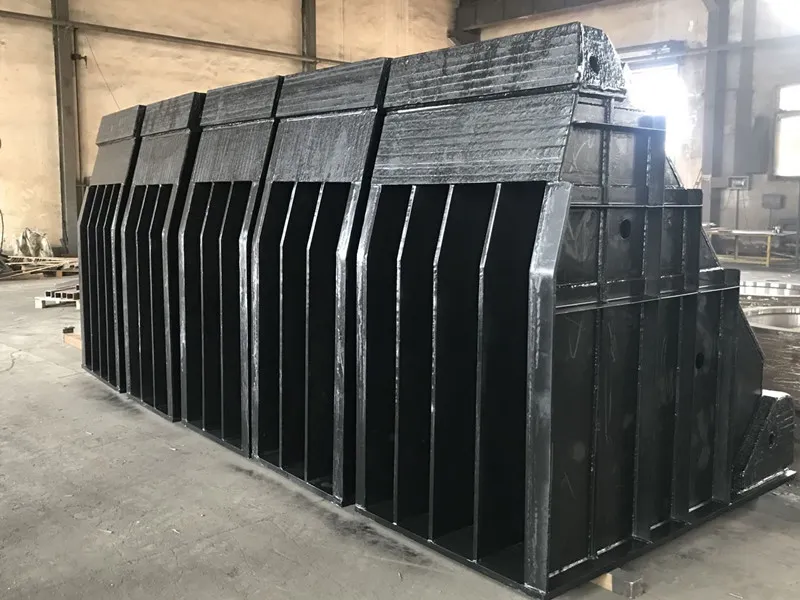
Thermal and Mechanical Demands on Sinter Breaker Stars
Operating Temperature Range (200–600°C) and Cyclic Thermal Stress Effects
The sinter breaker stars go through intense temperature swings ranging from around 200 degrees Celsius all the way up to 600 degrees Celsius when processing iron ore. All this constant heating and cooling causes the metal to expand and contract repeatedly, which leads to something called thermal fatigue. What happens next? Tiny cracks start forming on the surface, and these little flaws actually speed up how fast the material breaks down over time. When things get really hot, we see mostly compressive forces acting on the material. But once it starts cooling down, those forces flip to tension, causing gradual shape changes that build up over many cycles. At temperatures above about 500 degrees Celsius, another problem emerges as the carbides in regular hardfacing alloys begin to dissolve away. This process knocks roughly 15 to maybe even 20 percent off the hardness of the material, making it much less able to resist wearing away. So when choosing materials for these applications, certain factors need special attention.
- Low thermal expansion coefficients (<12 × 10⁻⁶/K) to limit dimensional instability
- High thermal conductivity (>25 W/m·K) for rapid heat dissipation
- Phase stability to prevent deleterious microstructural transformations
Dominant High-Temperature Wear Mechanisms: Thermal Cutting, Edge Blunting, and Break-Out Failure
Three interrelated failure modes govern performance in high-temperature sinter processing:
- Thermal Cutting: At 550–600°C, abrasive sinter particles gouge surfaces, removing 0.3–0.5 mm of material per operating cycle
- Edge Blunting: Impact loads exceeding 350 MPa deform cutting edges, reducing fragmentation efficiency by 40% after 200 hours
- Break-Out Failure: Thermal stress concentrations at geometric discontinuities nucleate and propagate cracks, culminating in catastrophic fracture
Oxidation intensifies all three mechanisms—wear rates increase threefold when surface temperatures exceed 450°C due to poor oxide scale adhesion and accelerated spallation. Material systems must therefore combine carbide stability with strong interfacial cohesion to withstand these synergistic degradation pathways.
Top Hardfacing Materials for High-Temperature Sieve Applications
Fe–Cr–C Alloys: Cost-Effective Thermal Stability with Moderate Oxidation Resistance
The Fe-Cr-C hardfacing alloys work well for most applications between around 200 and 450 degrees Celsius. What makes them special is their chromium carbide content which gives good protection against wear even when temperatures reach about 500 degrees. Plus these materials help form those protective oxide layers rich in chromium trioxide that we all know and love. The tempered martensite structure inside these alloys also helps them stand up better to repeated heating and cooling cycles without warping too much. But watch out what happens when things get hotter than 500 degrees especially if there's lots of temperature cycling going on because oxidation starts happening faster then. For many businesses looking at costs rather than pushing the limits of heat resistance, these alloys are still the go to option as long as operating temperatures don't regularly exceed 450 degrees Celsius.
NiCrBSi-Based Cermets and Nb/Mo/W/V-Enhanced Deposits for Superior Hot Hardness and Carbide Retention
Materials operating above 500 degrees Celsius, sometimes even reaching 600C continuously, benefit greatly from NiCrBSi based cermets strengthened with refractory metals like niobium, molybdenum, tungsten and vanadium. The base material made of nickel chromium boron silicon keeps its flexibility and resists oxidation even when things get really hot, plus it forms those stable boride and carbide structures we need. Adding niobium and vanadium actually changes how the carbides look under the microscope, which means parts stay harder longer in heat compared to regular alloys. Tests show about a third better performance in hot conditions. Tungsten and molybdenum do their part too by making sure the connection between carbides and the main material holds up better, so there's less chance of pieces breaking off during operation. Plasma transferred arc application gives us dense deposits with evenly spread carbides throughout, something absolutely essential for maintaining sharp edges and resisting impacts in those tough sintering environments where failures can be costly.
Microstructural Drivers of High-Temperature Wear Resistance
Carbide Type, Size, Distribution, and Interfacial Stability Under Thermal Cycling
The long term strength of materials really depends on how the carbides are arranged, not just how much there is. Different primary carbides behave differently in practice. For instance, M7C3 chromium carbides stand up well to oxidation, but when it comes to heat, MC type carbides made from vanadium or niobium perform better in terms of maintaining hardness at high temperatures and resisting grain growth. Size matters too big carbides over 10 microns tend to crack when subjected to impacts, while tiny ones below 1 micron start to grow bigger quickly once temperatures exceed 550 degrees Celsius, which actually reduces their hardness advantages. Getting the right distribution pattern helps spread out the load properly without creating weak spots where stress builds up. What matters most though is how stable the boundary remains between these carbides and the surrounding metal matrix. Materials that keep their interface intact after going through 1,000 heating and cooling cycles between 200 and 600 degrees show significantly less wear compared to those where the interface breaks down and small cracks begin to form.
H/E Ratio, Oxide Scale Adhesion, and the Limits of Ultrafine Carbide Refinement
The performance of these materials isn't just about carbide design. Bulk mechanical properties and what happens at the surface level matter too. When we look at the H/E ratio (that's hardness divided by elastic modulus), materials with higher values tend to resist plastic deformation during abrasive contact. This helps maintain those sharp edges needed for effective sinter fragmentation. At the same time, certain oxide scales form on the surface - think chromium oxide or aluminum oxide rich layers - acting as protective barriers against direct metal wear. But there's a catch. If the thermal expansion rates between these oxide layers and the base material don't match up, it can lead to spallation problems where parts start breaking off, leaving fresh surfaces vulnerable to faster wear. And here's another important point: when carbides get refined down below 0.5 microns, they hit thermodynamic limits around 600 degrees Celsius. Beyond that temperature range, the carbides start growing larger much faster, which degrades both hardness and how well different components stick together. That's why smart alloy development needs to balance carbide structures for both heat resistance and mechanical strength while also ensuring good oxide formation capabilities. Even the best carbide designs won't work if the H/E ratios aren't right or if those protective oxide layers fail to stick properly.
FAQ
What causes thermal fatigue in sinter breaker stars?
Thermal fatigue in sinter breaker stars is caused by repeated heating and cooling cycles. This process leads to expansion and contraction of the metal, eventually forming small cracks that accelerate material degradation.
Why is carbide stability important in high-temperature applications?
Carbide stability is crucial because stable carbides maintain hardness at high temperatures, resist oxidation, and limit grain growth, which helps increase wear resistance and longevity of materials used in extreme environments.
How does the H/E ratio affect wear resistance?
The H/E ratio, which is hardness divided by elastic modulus, affects wear resistance because materials with higher ratios tend to resist plastic deformation during abrasive interactions, maintaining sharp edges and effective fragmentation of sintered materials.