
 EN
EN
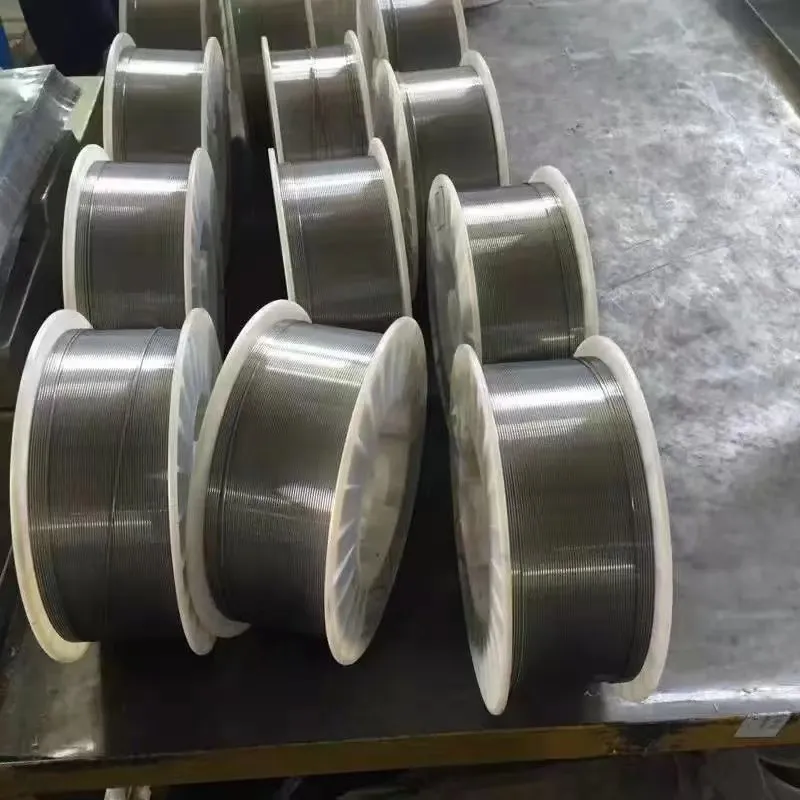
Inconsistent Bead Geometry and Surface Finish
How excessive dilution from traditional welding electrode degrades contour control and increases post-weld rework
When a conventional welding electrode deposits metal onto a hardfacing surface, excessive dilution commonly occurs—melting too deeply into the base metal and mixing filler with substrate. This alters the intended chemistry, undermining contour control: bead width and height become unpredictable, leading to waviness or uneven build-up. Irregular geometry creates stress concentration zones and forces extensive post-weld grinding or re-deposition. A 2023 study on wear overlay performance found that dilution rates above 15% increased rework time by an average of 40%. The remedy lies in selecting a process that inherently limits dilution and stabilizes the arc.
Flux-cored wire’s stable, self-shielding arc delivers repeatable bead profile and reduced spatter (AWS A5.21 compliant)
Flux-cored wire addresses dilution directly. Its self-shielding design produces a stable arc with consistent penetration, minimizing base metal mixing and yielding uniform bead geometry across passes. This repeatability reduces surface irregularities and spatter—thanks to optimized flux chemistry—resulting in a cleaner finish that requires less cleaning before subsequent layers. Electrodes compliant with AWS A5.21 standards deliver this predictable performance, enabling operators to achieve target hardness and wear resistance without excessive post-weld work. The outcome is a more efficient hardfacing process with fewer defects and lower cost per part.
Weak Adhesion and Premature Delamination Under Service Stress
When a hardfacing deposit peels away during service, the root cause is often weak interfacial bonding. Conventional electrodes frequently produce deposits whose composition misaligns with the substrate. Under thermal cycling or mechanical stress, mismatched thermal expansion concentrates strain along the fusion line. Repeated stress cycles gradually break atomic-level bonds, forming micro-gaps that evolve into visible cracks—and ultimately, full delamination. This failure exposes the base metal to wear and triggers costly rework and downtime. Prevention requires a filler metal capable of forming a metallurgically compatible transition layer resilient to real-world loads.
Microstructural incompatibility between base metal and welding electrode deposit accelerates interfacial cracking
The interfacial zone—where crystalline structures of base metal and deposit meet—is especially vulnerable when grain size or phase composition differ drastically. For example, applying high-chromium weld metal directly onto plain-carbon steel creates abrupt carbide volume changes, generating internal stresses. Because the two materials differ in ductility, these stresses cannot be relieved through plastic flow. Under abrasion or impact, the boundary fractures first. Flux-cored wire mitigates this by enabling gradual alloy blending, producing a gradient microstructure that softens the transition and resists interface cracking.
Rapid Decline in Wear Resistance in Abrasive Applications
Hardness drop >15% after ASTM G65 testing signals exhaustion of conventional welding electrode capability
A hardness reduction exceeding 15% following ASTM G65 abrasion testing is a clear indicator that conventional welding electrode deposits are losing their wear-resistant integrity. This decline reflects depletion of microstructural features—such as stable carbides—that provide resistance to particle erosion. Hardness serves as a reliable proxy for functional longevity; once it drops significantly, performance decays exponentially. Without robust microstructures, welded overlays degrade rapidly under abrasive service, becoming vulnerable surface layers rather than durable shields.
Flux-cored wire enables targeted carbide phase engineering (e.g., WC + Cr₇C₃) for sustained abrasion resistance
Flux-cored wire technology allows precise carbide-phase engineering. Manufacturers embed specific carbide-forming elements—like tungsten and chromium—into the flux core to promote formation of hard, stable phases such as WC and Cr₇C₃. Controlled deposition parameters ensure these phases survive service demands, embedding them within martensitic matrices tailored to the application. This scientific approach elevates carbon and chromium content strategically, stabilizing composites proven to withstand sand- and rock-induced wear. The result is sustained hardness, enabling thinner, longer-lasting overlays that maintain structural integrity over extended service life.
Excessive Heat Input Leading to Distortion and HAZ Embrittlement
Visible distortion after hardfacing is a telltale sign of excessive heat input from traditional welding electrodes. High amperage and slow travel speeds concentrate thermal energy, enlarging the heat-affected zone (HAZ) by up to 50% compared to optimized parameters. This overheating transforms the base metal’s microstructure—often forming hard, brittle untempered martensite—reducing toughness and increasing susceptibility to cracking under impact or cyclic loading. Simultaneously, uneven thermal expansion and contraction cause warping or bowing, compromising dimensional stability and requiring costly rework. Thinner sections are especially vulnerable due to limited thermal mass. In severe cases, accumulated internal stresses exceed yield strength, causing permanent distortion that affects fit-up and alignment. While lowering current, increasing travel speed, or using weaving techniques can help reduce heat input, these adjustments often sacrifice deposition rate or penetration. The fundamental limitation remains: many conventional electrodes lack the arc control needed to balance efficiency with low heat input—making advanced consumables like flux-cored wire essential for precision hardfacing.
FAQ
What is excessive dilution in welding, and why is it a problem?
Excessive dilution occurs when the welding electrode melts too deeply into the base metal, causing filler material and substrate to mix excessively. This changes the intended chemical composition and results in irregular bead geometry, which often leads to stress concentrations and rework.
How does flux-cored wire reduce spatter and improve surface finish?
Flux-cored wire uses a self-shielding design that creates a stable arc with consistent penetration. Its optimized flux chemistry minimizes base metal mixing and yields a cleaner finish, which requires less preparation for subsequent passes.
Why does premature delamination occur in hardfacing deposits?
Premature delamination often results from weak interfacial bonding due to a mismatch in the thermal expansion or composition between the base metal and the weld deposit. This mismatch generates strains along the fusion line, leading to cracks and delamination under stress.
What contributes to the rapid decline in wear resistance in abrasive applications?
This decline often stems from the depletion of microstructural features like stable carbides, which are essential for wear resistance. Conventional electrodes may not create robust enough microstructural phases to withstand abrasive conditions over time.
How does heat input during welding affect the quality of the hardfacing?
Excessive heat input can lead to distortion, enlarging the heat-affected zone (HAZ) and forming brittle microstructures. This increases susceptibility to cracking, warping, and other defects, especially in thinner sections.